Release 8: CIA UFO Papers, AAWSAP Records, and Three UAP Videos
What happens when a government UFO release contains both an extraordinary claim and the internal review that questioned it? Release 8 offers a revealing example. A 2009 letter from Senator Harry Reid called for extraordinary security around an advanced aerospace program. A Defense Intelligence Agency review later that year said the material it had seen did not justify a restricted special access program.
Released on November 20, 2026, the collection contains 40 PDFs and three videos. The documents range from 1952 CIA memoranda and historical Air Force sighting reports to records of the Advanced Aerospace Weapon System Applications Program (AAWSAP) and a radar detection described in the document as occurring in 2023. The videos add three sensor recordings, though the available information does not identify what they show.
This is a first look at the collection, not a finding that every case has been independently resolved or that every document has been reviewed in full. As with Release 7, a proposal, a witness account, an intelligence assessment, and an instrument recording are different kinds of evidence.
What the 1952 CIA papers show
Six CIA files return to the wave of flying-saucer reports that drew national attention in 1952. They show officials wrestling with a mixture of unexplained observations, public concern, and Cold War security questions.
An August assessment said many reports could be explained as known aircraft, weather balloons, natural phenomena, or unreliable reports. It described fewer than 100 as still unexplained at that point and suggested that better information might eventually account for them too. The author nevertheless recommended continued intelligence coverage; an unresolved report was not, in itself, a confirmed extraordinary object (CIA-UAP-D026, p. 1).
Another paper considered whether confusion surrounding flying-saucer reports could affect warning systems or be exploited by an adversary. Its author also said it was too early for psychological-warfare planners to devise ways to use supposed U.S. flying saucers against an enemy (CIA-UAP-D028, pp. 1–2). A separate memorandum proposed discussing possible offensive or defensive psychological-warfare uses of the phenomena (CIA-UAP-D025, p. 1). Those are concerns and proposals in historical records, not evidence that such a plan was carried out.
A further memorandum sought approval in principle for outside scientists to evaluate the available evidence and recommend next steps. The copy calls for preliminary negotiations and later final approval; the proposal itself should not be confused with proof of a completed study (CIA-UAP-D024, pp. 2–3).
Reid's request and DIA's response
The AAWSAP records provide a useful companion to the BAASS and DIA files in Release 7. They include the 2008 solicitation, a 2009 letter from Reid, talking papers, reviews of the contractor's work, and a 2010 DIA memorandum.
The solicitation sought studies of potential breakthrough aerospace technologies and foreign threats looking toward 2050, across fields including propulsion, materials, power generation, and signature reduction (DOW-UAP-D182, p. 2). A May 2009 DIA talking paper says Bigelow Aerospace Advanced Space Studies (BAASS) submitted the only bid and received the contract (DOW-UAP-D184, p. 1).
In his June 24, 2009 letter, Reid wrote that the program had identified sensitive, unconventional aerospace-related findings and requested a restricted special access program for portions of the work (DOW-UAP-D183, pp. 1–2). That is the senator's characterization and request—not independent confirmation that the findings represented operational exotic technology.
The November 2009 DIA review reached a different conclusion. It said the agency could not find adequate justification for a restricted special access program based on the deliverables and projected work, and was unaware of a report containing information sufficiently sensitive to require that additional protection (DOW-UAP-D185, pp. 1–2). A 2010 DIA memorandum also said the reports were considered of limited value to DIA, while suggesting they might be useful to other organizations (DOW-UAP-D186, p. 2).
There is a further distinction worth preserving: an October 2009 review described the technical reviews it cited as positive (DOW-UAP-D188, p. 1). Positive assessments of the papers' quality, DIA's later assessment of their value to the agency, and the decision about extra security are separate judgments. None establishes that the technologies discussed were built or demonstrated.
BAASS's 538-page ten-month report from July 2009 describes its organization, investigations, contracted research, and plans (DOW-UAP-D172). It says the CAPELLA warehouse held nine databases with more than 237,000 UAP events (pp. 224–225). That is the contractor's reported count, not an independent audit or a count of confirmed anomalous objects. In an Oregon investigation, the report also notes conflicting witness statements and says surveillance recorded no reportable UAP (pp. 59–61).
A radar track with an important caveat
One of the most striking modern items is DOW-UAP-D165, a one-page summary of a 2023 U.S. civil air-surveillance radar detection. It reports eight detections over 84 seconds at an estimated altitude of 55,000–70,000 feet. If all eight belonged to a single object, the report calculates a minimum mean horizontal groundspeed of about 1,650 mph from the summed distances between detections.
The condition is crucial. The same summary says the 12-second radar sweep interval cannot independently establish that all eight detections came from the same object or formed a continuous track. Its connecting line shows displacement between points, not a reconstructed flight path. The calculated speed is therefore a conditional estimate, not a verified measurement of one object's performance.
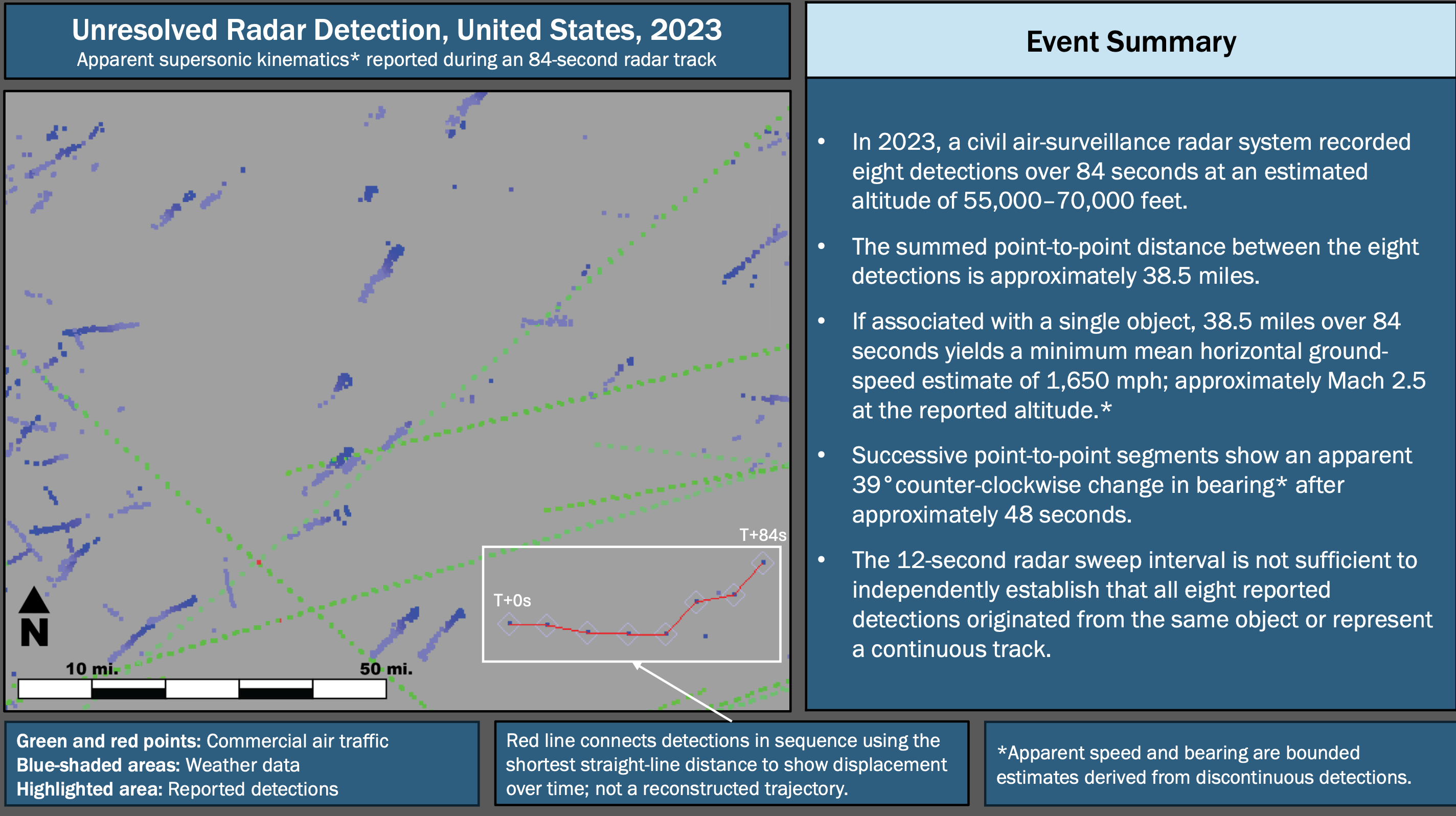
The release database labels the document as a 2023 case but displays a different incident date in its listing. The 2023 date above follows the PDF itself; the discrepancy warrants clarification.
Historical sightings: read the conclusions, too
The Air Force files include reports from the United States and overseas, alongside a group of California case files. Their filenames and release categories are a starting point, not a substitute for the original investigators' conclusions.
For example, the record card in DOW-UAP-D207 describes three reported sightings over Fontana and La Jolla in 1956 but marks all three as aircraft (p. 1). DOW-UAP-D210's card identifies a 1957 Southern California sighting as a meteor (p. 1). DOW-UAP-D213 describes two bright, oval objects reported over Glendale in 1949; its card says the data did not show that they could not have been aircraft (p. 1).
These assessments are historical judgments, not proof that every associated detail was settled. They are also a reminder that a file labeled “unresolved” in a release can contain an investigator's conventional explanation.
Document index
The summaries below are an orientation to the supplied PDFs, not independent verification of the accounts or a substitute for reading the records. Page numbers refer to pages in the PDF, including cover or routing pages.
CIA records
| Document | Summary |
|---|---|
| CIA-UAP-D024 | A proposed external project would convene scientists to assess UFO evidence and recommend next steps; it requests approval in principle, followed by final approval later (pp. 2–3). |
| CIA-UAP-D025 | The CIA director proposes discussing possible psychological-warfare implications of flying-saucer reports; the memorandum is a proposal, not proof of an implemented operation (p. 1). |
| CIA-UAP-D026 | An August 1952 assessment says many reports had conventional explanations, while fewer than 100 credible reports remained unexplained; it recommends continued monitoring (p. 1). |
| CIA-UAP-D027 | An Office of Scientific Intelligence briefing reviews the Air Force study, reported sightings, explanations, and intelligence implications; its introduction says it makes no recommendations for action (pp. 1–3). |
| CIA-UAP-D028 | An October 1952 memorandum discusses possible effects on warning systems and Soviet capabilities, while cautioning that psychological-warfare planning would be premature (pp. 1–2). |
| CIA-UAP-D029 | An October 1952 diary entry notes additional sighting reports and a proposed briefing on speculative propulsion ideas; the entry does not establish that the ideas were demonstrated (p. 2). |
Radar and AAWSAP records
| Document | Summary |
|---|---|
| DOW-UAP-D165 | A 2023 radar summary reports eight detections over 84 seconds and calculates a conditional speed estimate, while acknowledging the detections may not represent one continuous track (p. 1). |
| DOW-UAP-D172 | BAASS's ten-month report describes its organization, investigations, contracted research, projects, and future plans. It is the contractor's account, not independent confirmation of its case claims (pp. 3, 7, 118–120, 479). |
| DOW-UAP-D182 | The 2008 AAWSAP solicitation describes technical studies of potential breakthrough aerospace applications and future foreign threats (pp. 1–2). |
| DOW-UAP-D183 | Senator Harry Reid requests restricted special access protection for portions of the program and describes his concerns about sensitive findings (pp. 1–3). |
| DOW-UAP-D184 | A May 2009 DIA talking paper describes BAASS's contract, technical plans, and the program's status for a possible discussion with Reid (pp. 1–2). |
| DOW-UAP-D185 | A November 2009 DIA review finds insufficient justification for a restricted special access program based on the deliverables and projected work (pp. 1–2). |
| DOW-UAP-D186 | A 2010 DIA memorandum summarizes funding and research reports, recounts the security review, and says the reports were considered of limited value to DIA (pp. 1–2). |
| DOW-UAP-D187 | A January 2009 DIA talking paper reports on BAASS's technical plans, facility clearance process, and contract schedule (p. 1). |
| DOW-UAP-D188 | An October 2009 DIA review describes the first-year technical reports and cites positive reviews of selected papers (pp. 1–2). |
Historical Air Force reports
These summaries distinguish what witnesses reported from explanations recorded by investigators. They do not independently establish either account. Some PDFs contain more than one sighting.
| Document | Summary |
|---|---|
| DOW-UAP-D189 | Near Great Falls, Virginia, two observers looking for Sputnik reported a small dark speck moving overhead. The source was unevaluated, and the preparing officer offered no explanation (pp. 3–5). |
| DOW-UAP-D190 | People fishing near Martha's Vineyard reported an aluminum-colored cylindrical object that appeared to reverse direction. Only one observer was interviewed, and the officer did not investigate or analyze the sighting (pp. 3–4, 6). |
| DOW-UAP-D191 | The Levelland, Texas file contains several differing reports, including a motorist's account of an oval object and a stalled car. The officer considered weather or reflected gas fires possible, forwarded the principal sighting as unresolved, and cautioned against linking all the reports (pp. 5, 18, 21). |
| DOW-UAP-D192 | A witness near Kearney, Nebraska, reported seeing a landed object and its occupants. Investigators assessed the account as a hallucination motivated by publicity; that is their judgment, not an independently established finding (p. 3). |
| DOW-UAP-D193 | Two military police patrols at White Sands separately reported bright objects, one apparently descending and another rising. The preparing officer attributed the sightings to the setting moon and Venus, respectively (pp. 4–5, 8). |
| DOW-UAP-D194 | A motorist south of Orogrande reported a pearly object making two passes and said his car and radio faltered. The officer suggested an optical phenomenon and noted inconsistencies in the account (pp. 4–5, 7). |
| DOW-UAP-D195 | Two Kirtland Air Force Base tower operators reported a lighted object descending near the field and climbing away; radar personnel also reported an unidentified radar return. The preparing officer considered an unidentified aircraft a possibility (pp. 4, 6–7). |
| DOW-UAP-D196 | Near Moses Lake, an observer reported a bright, color-changing object moving west and sinking below the horizon. A control station thought it was Pluto; the observer considered a solar-system object but questioned its apparent speed (pp. 5–6). |
| DOW-UAP-D197 | Two observers near Lake Erie in Michigan described a bell-shaped, silver-gray object crossing their view for eight to ten seconds. Their distance and speed figures were estimates (pp. 3–4). |
| DOW-UAP-D198 | An Air Force report translates a Japanese newspaper article claiming the Soviet Union was manufacturing a vertically ascending flying disk. The preparing office described the article as its first information on the claimed aircraft, not confirmation it existed (pp. 3–4). |
| DOW-UAP-D199 | Observers over Tehran reported a high east-to-west vapor trail lasting about three and a half minutes; no object or sound was detected, and the source evaluation was unknown (p. 3). |
| DOW-UAP-D200 | A Peru report combines an account of an aqua-colored luminous object apparently falling near Andahuaylas with a separate persistent bright object seen near Cajamarca. The latter was described as possibly balloon-like but too high to identify (p. 3). |
| DOW-UAP-D201 | A consular report collects several sightings over Iranian Azerbaijan. A newspaper speculated that one October object was Sputnik I; the report did not establish that identification (p. 3). |
| DOW-UAP-D202 | A weather observer near Cajamarca recorded repeated sightings of a gleaming object and measured its changing position with a theodolite. Clouds and visibility limited observations, and the report did not identify the object (pp. 3–6). |
| DOW-UAP-D203 | An unidentified object was reported on two predawn mornings near Upland, California. The preparing officer said the available information was insufficient in quantity and detail for analysis (pp. 3, 5–6). |
| DOW-UAP-D204 | Three Virginia witnesses described a glowing red-orange object in November 1957 but differed in their descriptions of its shape. The report does not establish an identification (pp. 3, 6, 8). |
| DOW-UAP-D205 | Near Ube, Japan, an F-86D pilot reported an unidentified radar return and an intermittent visual object. Radar interference was noted, and ground stations reported no corresponding unidentified track; the officer cautioned against giving that absence much weight (pp. 1–4). |
| DOW-UAP-D206 | Lockheed personnel reported a dark, apparently stationary object near Agoura in 1953. The Air Force record card classified it as a lenticular cloud (pp. 1, 6, 9). |
| DOW-UAP-D207 | Three California sightings included red lights with apparent tails and two yellow-white lights flying in formation. The record card evaluated all three as aircraft (p. 1). |
| DOW-UAP-D208 | Observers at Palos Verdes reported a round object with flashing red, white, and blue lights near Catalina Island. Project Blue Book initially found the information insufficient for evaluation and requested questionnaires (pp. 1–2, 4–5). |
| DOW-UAP-D209 | A witness near Catalina Island reported a bright orange-to-red object falling straight downward for about two seconds. The investigating organization considered it probably a meteor (pp. 1–2, 4). |
| DOW-UAP-D210 | Multiple ground and airborne reports describe brief bright objects over Southern California in November 1957. The record card classified the event as a meteor, although individual descriptions and estimated durations varied (pp. 1, 5–6, 10, 12). |
| DOW-UAP-D211 | A Fontana observer reported a round red object with a tail moving east and fading into fog. The record card suggested it was probably a jet aircraft with a contrail (p. 1). |
| DOW-UAP-D212 | A San Pedro record describes a bright white light with a red center and lists a possible hot-air balloon. The PDF also contains a separate Massachusetts sighting that a civilian investigator considered possibly a mirage, with insufficient evidence for a firm conclusion (pp. 1, 15, 21). |
| DOW-UAP-D213 | The Glendale record describes two bright metallic oval objects reflecting sunlight; its card classified them as aircraft, saying the data did not rule aircraft out. The PDF also includes a separate La Jolla sighting (pp. 1–2, 4). |
The three videos
The release lists three Middle East cases submitted by U.S. Central Command to the All-domain Anomaly Resolution Office (AARO). These notes summarize the government's descriptions, which explicitly say they are informational rather than analytical conclusions:
| Case ID | Year in case description | Approximate file duration | Official description | YouTube |
|---|---|---|---|---|
| DOW-UAP-PR166 | 2020 | 21 seconds | An area of contrast crosses the frame; an infrared sensor pans and changes magnification while tracking it. | Watch |
| DOW-UAP-PR168 | 2026 | 55 seconds | An electro-optical and infrared system tracks multiple areas of contrast, changes magnification, and intermittently loses contact with two areas. | Watch |
| DOW-UAP-PR169 | 2023 | 14 seconds | An electro-optical and infrared system pans to keep an area of contrast generally centered. | Watch |
The year and region are taken from the case titles and descriptions; the database's incident-date fields do not agree with those years, and the PR169 detail also shows a different “Date Taken.” The exact dates therefore remain uncertain. The durations above are rounded from the supplied video files.
Sampled frames show monochrome imagery with targeting overlays and redacted areas. The descriptions do not establish the objects' identities, distances, or speeds. The Release 6 video dossier offers useful context on why sensor movement, magnification, and interrupted views matter.
The takeaway so far
Release 8 is especially valuable for putting records in conversation: the CIA's Cold War concerns beside its own cautious assessments, and Reid's security request beside the DIA's response. The radar summary is equally instructive because it states the assumption behind its dramatic speed estimate.
There is more to examine, particularly the underlying material in the long BAASS report, the historical case files, and the complete video recordings. For now, the collection supports a careful account of what officials proposed, reported, and assessed—not a conclusion that an extraterrestrial craft or extraordinary performance has been established.
Primary source: Department of War PURSUE records. Select “eighth tranche of records” at the top to open Release 8, then search by case ID. The document citations also refer to the supplied PDFs and their page numbers.